
Ep. 6 American Revolution Finale Warns of Trump
The Revolution Continues & My Deep Dive into Indigenous Democracy

Hi you.
This is it. I’m wrapping up my reviews of Ken Burns’s The American Revolution with this post. The full set is available in this collection.
There is a lot to note in this episode, and I won’t get to it all. But I gotta acknowledge this line, “fueled by rum and righteous indignation,” in reference to a mutiny by Pennsylvania Continental soldiers who hadn’t been paid in far too long. This War was the hottest of messes, and I guess that’s the point. We’ve gotten a bit more color, nuance, and truth from this series, even with a few glaring omissions.
Here are my highlights, followed by a transition into very special project I’m part of which picks up where this series leaves off.
Hamilton Tried To Warn Us About Trump
The First Civil War
What Benedict Arnold and George Washington Share
Black Folk Been Known
Indigenous Omission and a Refounding Opportunity for All
I’m doing a Substack Live next Weds Dec 3, 3pm PT.
Hamilton Warns of a Demagogue
In the closing 15 minutes of this episode and thus the entire series, Burns & Co. rapidly race through the end of the war, the establishment of the Constitution, and the creation and adoption of the Bill of Rights. It’s a lot to cover in a little time, but they managed to squeeze in a small but important bit about the limitations of the structure the Founders created.
They specifically call out the warnings of abuse of power.
They feared that a demagogue might incite citizens into betraying the American experiment. Alexander Hamilton was concerned that an unprincipled man would mount the hobby horse of popularity and throw things into confusion: "In a government like ours,” he would write, “no one is above the law.”
It’s very popular these days for pundits to proclaim something along the lines of, “The founders could never have imagined the country we live in now… They could never have predicted Trump.” But they literally imagined and warned against it.
How else can we interpret the still-formidable popularity of a president who has betrayed the principles of democracy so fully? The flagrant and open corruption (hello, memecoins); the deployment of military force in American cities outside of wartime; the refusal to be bound by judicial orders; the constant dehumanization of opponents and weaponization of the powers of the state against them. The remarkable thing about Donald Trump isn’t his behavior but the capitulation of much of the Republican Party and the general public into accepting and even celebrating such behavior.
I still have faith that we the people will awaken and remember who we have always had the potential to become, but we are where we are because we didn’t head warnings like those of Hamilton back in the 1780s.
The Revolutionary War as Our First Civil War
The series has made the point repeatedly that much of the ideological and armed conflict of the American Revolution was not between British soldiers and those born on this land but between and among people born on this land torn between loyalty to The Crown and allegiance to and burgeoning republic, aka Patriots.
Historian Vincent Brown, who’s become one of my favorite voices in this series:
That war in South Carolina is bloody. It’s a gorilla conflict. It’s sometimes brother against brother in this backwoods warfare. It’s an ugly, ugly, ugly conflict. And if one wants a national origin story that’s clean and neat and tells you very clearly who the good guys are and who the bad guys are, the American Revolution in South Carolina is not that story.
Historian Edward Lengel on the brutality
Patriots murder many of their captives. If they see somebody among the captives who gives them a dirty look, they’ll say, “Oh, I know that guy. He burned a farm just over the next hill, and he killed somebody’s family. Let’s string him up.” And so all kinds of atrocities take place.
The official narrator adds to the chronicle of horrors
Partisans on both sides seemed bent on being more cruel than those on the other. They tortured and murdered captives, burned homes, and flogged their owners, raped women, and hanged their husbands. Gangs of bandits held up travelers and plundered farms.
This was all preamble to the Civil War unfortunately.
Benedict Arnold and George Washington Are The Same
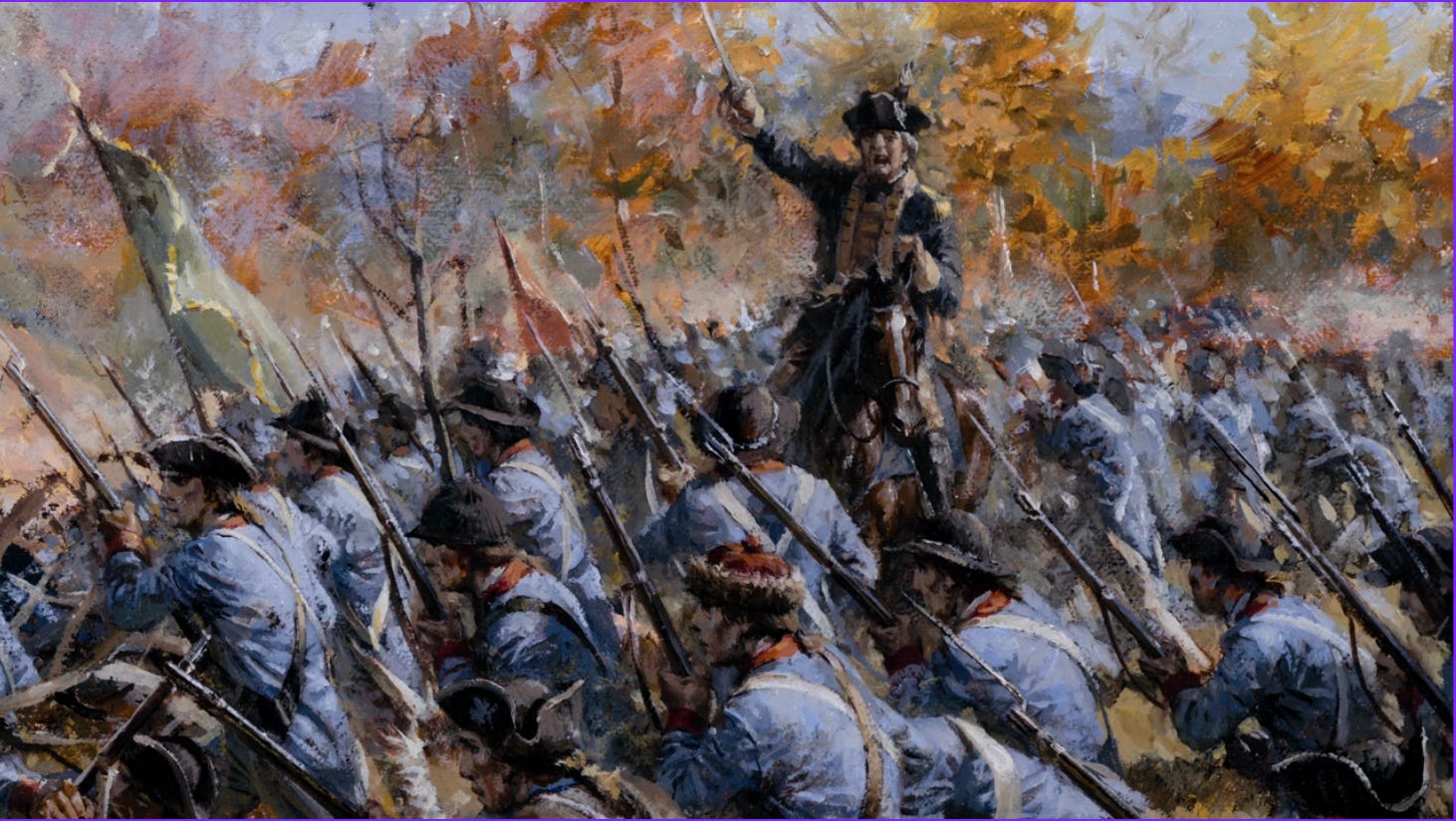
Hear me out.
There were two major reasons George Washington turned against the British that had nothing to do with morality or noble dreams of an independent nation. First, he was bitter that the British Army failed to recognize his contributions in the colonial era. As was mentioned in the first episode, “after his appeal for a Royal Commission in the British Army was rejected, he retired from military service in 1758, and returned to his plantation at Mount Vernon, filled with resentment at how the British had treated him.” It’s a tale as old as employer-employee relationships. Ole boy wanted a promotion and didn’t get one, so he turned against his bosses. But not only that.
Washington was also greedy. A 1763 royal proclamation declared lands west of the Appalachian mountains off limits to colonial settlement and speculation. Here’s the narrator in Episode 1
After abandoning his dream of serving as an officer in the British Army, George Washington had married an enormously wealthy widow, Martha Dandridge Custis, and had made himself still wealthier speculating in western lands. He saw no reason to stop. “The law was only a temporary measure to quiet the minds of the Indians,” he said, and he directed his land agent to defy the proclamation and secure for him some of the most valuable lands beyond the Appalachians.
Washington felt he wasn’t recognized and wasn’t rich enough. Now that we see Washington for the human he was, let’s take a fresh look at Benedict Arnold.
Update: I forgot to mention my whole-hearted endorsement of the AMC series, TURN: Washington’s Spies. It has some great storylines about the Revolutionary War and Arnold. Very entertaining. Ok now, back to the original post.
This is a man who made repeated battlefield sacrifices but also felt insufficiently recognized. As historian Nathaniel Philbrick notes:
He had done all these miracles on the battlefield, but he was not seeing any of the recognition he believed he deserved. Why am I doing this? I’ve lost my personal finances. I’ve my destroyed my body. For what?
He also fell in love with a woman on the Loyalist side and probably wanted to build that good life with her, requiring money, which the British handsomely offered. My eyes popped at the sums. Arnold was offered £20,000 upfront and £500 per year for the rest of his life, but the series doesn’t translate that money into today’s dollars. I did.
In very approximate 2025 U.S. dollars, Arnold’s deal looks like:
Up‑front £20,000 ≈ $6 million in today’s buying power.
£500 per year for life ≈ $150,000 per year in today’s buying power.
I mean, I completely understand the man’s choices! And more to the point, they look a lot like George Washington’s. These were the same men in many ways, driven by the same personal motivations for recognition in name and in wealth. They happened to land on opposite sides of this conflict, but they were fighting the same war, and it was a personal war for greed and glory.
Black Folks Been Believing In America More Than America From Jump
Back in the 2020-21 era, I was making a lot of appearances on Brian Williams’s The 11th Hour show on MSNBC (now MS NOW). In one moment that went semi-viral, I expressed pain and fury at the matter-of-fact reality that Black people have repeatedly shown up for an America that most Americans haven’t. We have fought for a nation that didn’t fight for us. “You don’t get to be more American than being owned by America.”
I knew this in my body and bones, and it’s pretty self-evident from history. This series has offered multiple specific moments at the formation of the United States demonstrating that beautiful invocation by Black Americans to, as Langston Hughes put it, “Let America be America again.”
So we gotta talk about Elizabeth Freeman neé Mumbet.
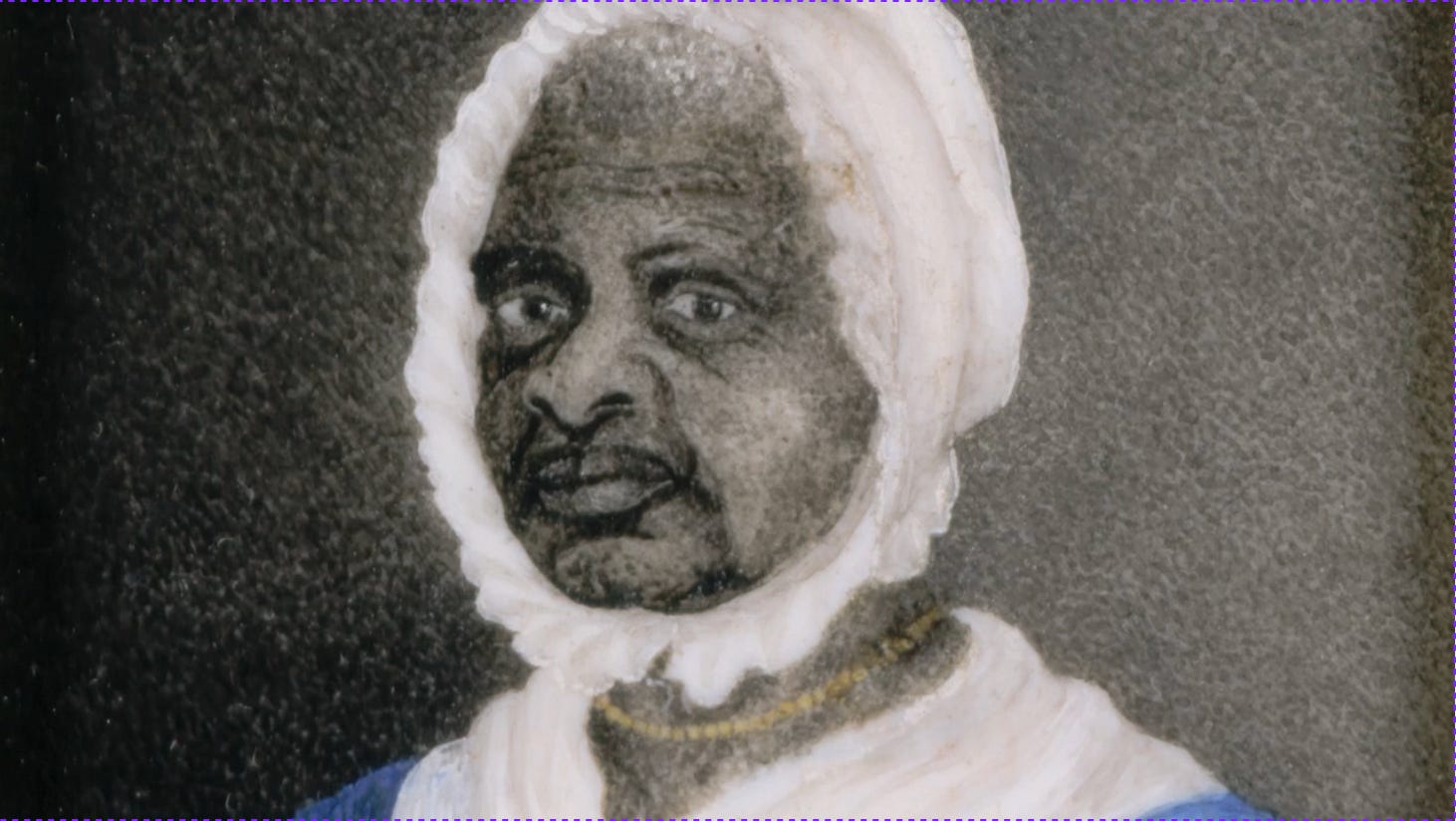
When an enslaved woman in Western Massachusetts called Mumbet was struck by her mistress with a kitchen shovel, she had stalked from the house and refused to return. Her owner went to court to get her back. Mumbet’s lawyer convinced an all white jury that since the preamble to the new Massachusetts State Constitution declared all men free and equal, and since his client was a human being, she should be free. The Massachusetts Supreme Court agreed.
Mumbet changed her name to Elizabeth Freeman and lived nearly 50 years in Stockbridge serving her neighbors as a healer, nurse, and midwife. Her gravestone in a Stockbridge cemetery reads, “She was born a slave. Yet in her own sphere, she had no superior nor equal.”
And we gotta talk about James Forton.
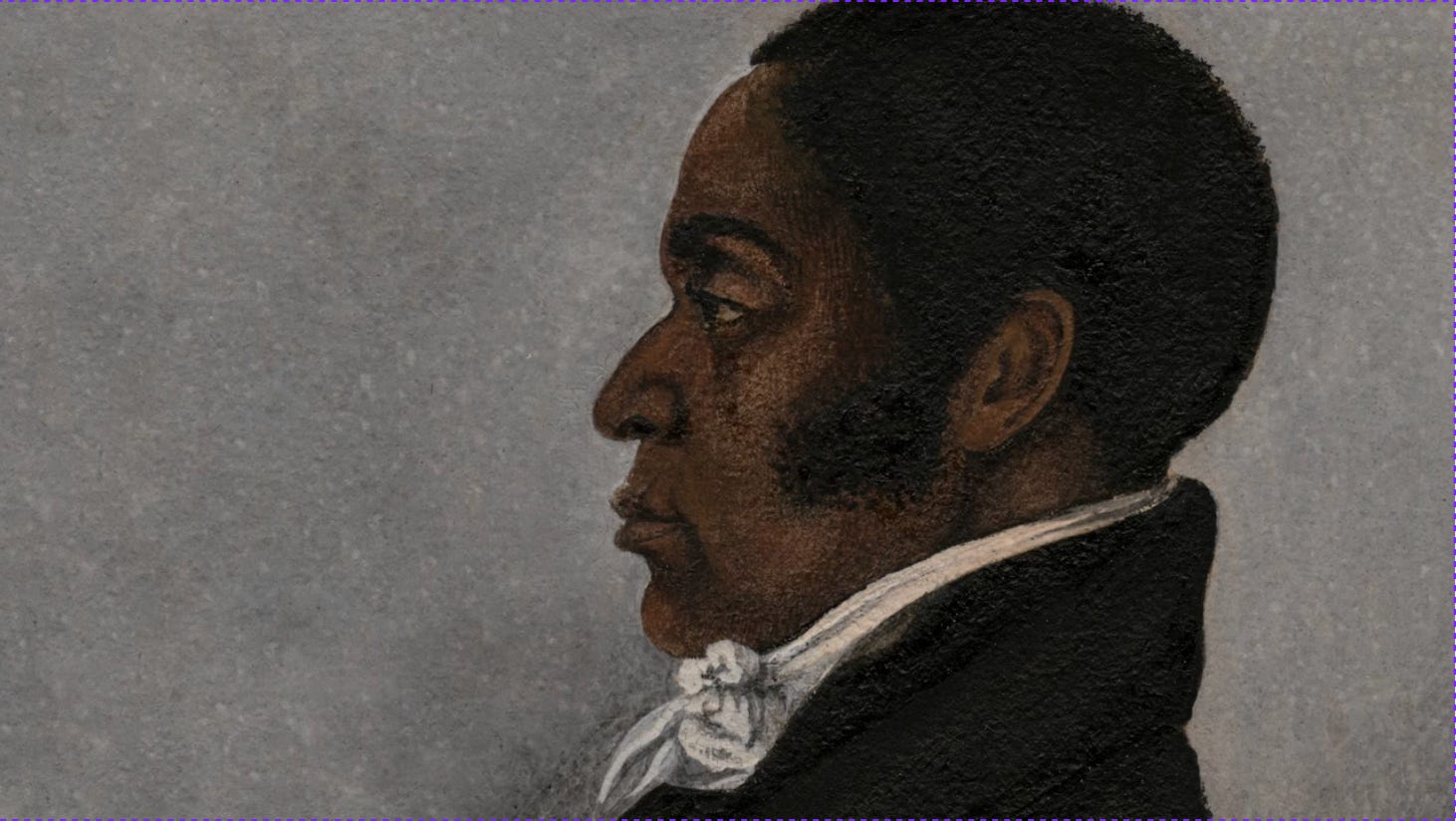
James Forton was born free in Philadelphia at 9. He had been in the crowd at the Pennsylvania State House that heard the Declaration of Independence read to the public for the very first time.
Forton took the promise of the declaration to heart and never questioned whether its self-evident truths applied to him. Now in the summer of 1781, Forton was 14, old enough to fight for his country.
Forton went on to fight on privateer ships and get imprisoned on a British prison barge on the East River and after the war walked his way, barefoot, home to Philadelphia where he refused a pension because he was a volunteer. Come on, man!
Whether they fully meant it or not, these Founders wrote some things down and made some promises, like we are all equal. As I mentioned four years ago in the clip above, “It sometimes feels like we’re dragging America, kick and screaming, towards its own creed.” We get to decide to take the words seriously and live up to and into them. Words matter.
Back To The Future, Remembering Indigenous Roots
So that brings me to now and then at the same time. What I didn’t know when I spoke to Brian Williams in 2021 and what is glancingly but insufficiently acknowledged in this new series, The American Revolution, is that the Founders themselves were inspired by words and principles and practices of people here before all of us: the Indigenous nations and particularly the nations of the Haudenosaunee Confederacy.
This week an article I’ve been working on for months is finally in the world in Atmos.

It reads, in part…
Onondaga Chief Canassatego addressed an intercolonial gathering in Lancaster, Pennsylvania, encouraging them to learn from the Haudenosaunee model: “Our wise forefathers established union and amity between the Five Nations. This has made us formidable … Do the same. Never fall out with one another.” He said this on July 4, 1744.
Benjamin Franklin paid attention. He printed Canassatego’s speech and shipped hundreds of copies to London. As Pennsylvania’s Indian commissioner, he sat in council with Haudenosaunee leaders and witnessed their governance firsthand. In 1750, he wrote, “It would be a very strange thing, if six Nations of ignorant savages should be capable of forming a Scheme for such a Union … and yet that a like Union should be impracticable for ten or a Dozen English Colonies.”
The PBS series does more than most stories of such prominence to acknowledge the fact that there was a democracy already present when the colonists arrived. The series paints a more honest picture than most at the degree to which the battle for independence was really a battle for Indigenous land. But the series falls short on the thinking of these times, the revolutionary ideas at play. It does so in service of attention to military battles and campaigns, in a focus on the war more than the revolution. Public historian Tad Stoermer captures that trade-off in his latest essay. But there was and remains powerful and influential thinking and practice of a deeper democracy that the Founders were invited into.
And that is the subject of our present opportunity and much of my time in this past year and a half, mostly out of public view. With the 250th anniversary of the Declaration of Independence, we have an opportunity to renew our vows to each other on a different set of principles, ones less corrupted by the selfish fantasies of empire that drove much of The American Revolution, but instead rooted in deeper principles of equality, ecological reciprocity, gender balance, long-term vision, and peace. These are principles of interdependence, and I believe we are being called to remember them and live up to and into those as well.
There are many efforts in this arena. I happen to come to one through Indigenous relationship that I find deeply weaving with the Black experience and the experience of all who truly value life and freedom, the kind of freedom that doesn’t come at the expense of others but the kind that can only be experience with the liberation of all.
The final words of Burns’s series come from historian Benjamin Rush. He notes that the war may have ended, but, “the revolution is not over.” I agree.
Next week, right here on Substack, I’ll do a live reading and talkback with you about the Atmos article, the Ken Burns series, and anything else on your mind. It’s scheduled for Wednesday December 3, 2025 at 3pm PT, 6pm ET.
Get the Substack app so you are notified when we start and you can pop in!
Thank you for sharing your power in the form of your time and attention.
This has been a labor of radical love and radical inconvenience, to be honest, but I’m grateful to PBS and Ken Burns for elevating a more complex story of our national origin and providing momentum for the rest of us to run with it, even bigger, into the future.
As always, I welcome your reflection on the series via comments.
And do share this with others.
Great points all! This piece summarizes what I saw in the series too. It occurred to me that all the forces that motivated men then are present today. (Humans will be human…) the whitewashing of history that I learned as a child - wow, how that perpetuated a white supremacy narrative around the founders, that served the purpose of thwarting the power of all of us.
I haven't watched the series yet, but I appreciate your commentary and will keep it in mind.